EFT for Insomnia
By Charis Kaps, BSc (Hons) Neuroscience, Accredited EFT Practitioner and Counsellor.
If you struggle with sleep, you'll know that it can affect your mood, concentration, relationships, physical health and quality of life. You don't have to work through it on your own.
Insomnia can have many causes, including medical conditions, medication, sleep disorders, trauma and lifestyle factors. If you're experiencing persistent sleep difficulties, it's important that they are appropriately assessed by your GP or another healthcare professional.
For many people, however, stress, anxiety and emotional arousal also play an important role in keeping insomnia going.
Sleep isn't a conscious decision. It is an automatic biological process that happens when the brain and nervous system recognise that it is safe to switch off.
After weeks or months of poor sleep, it is common for the nervous system to become increasingly alert. You might begin worrying about whether you'll sleep, watching the clock, becoming frustrated that you're still awake, or dreading bedtime altogether.
This is often described as hyperarousal—a state in which the brain and nervous system remain on high alert, even when you're exhausted.
How Insomnia Can Become A Cycle
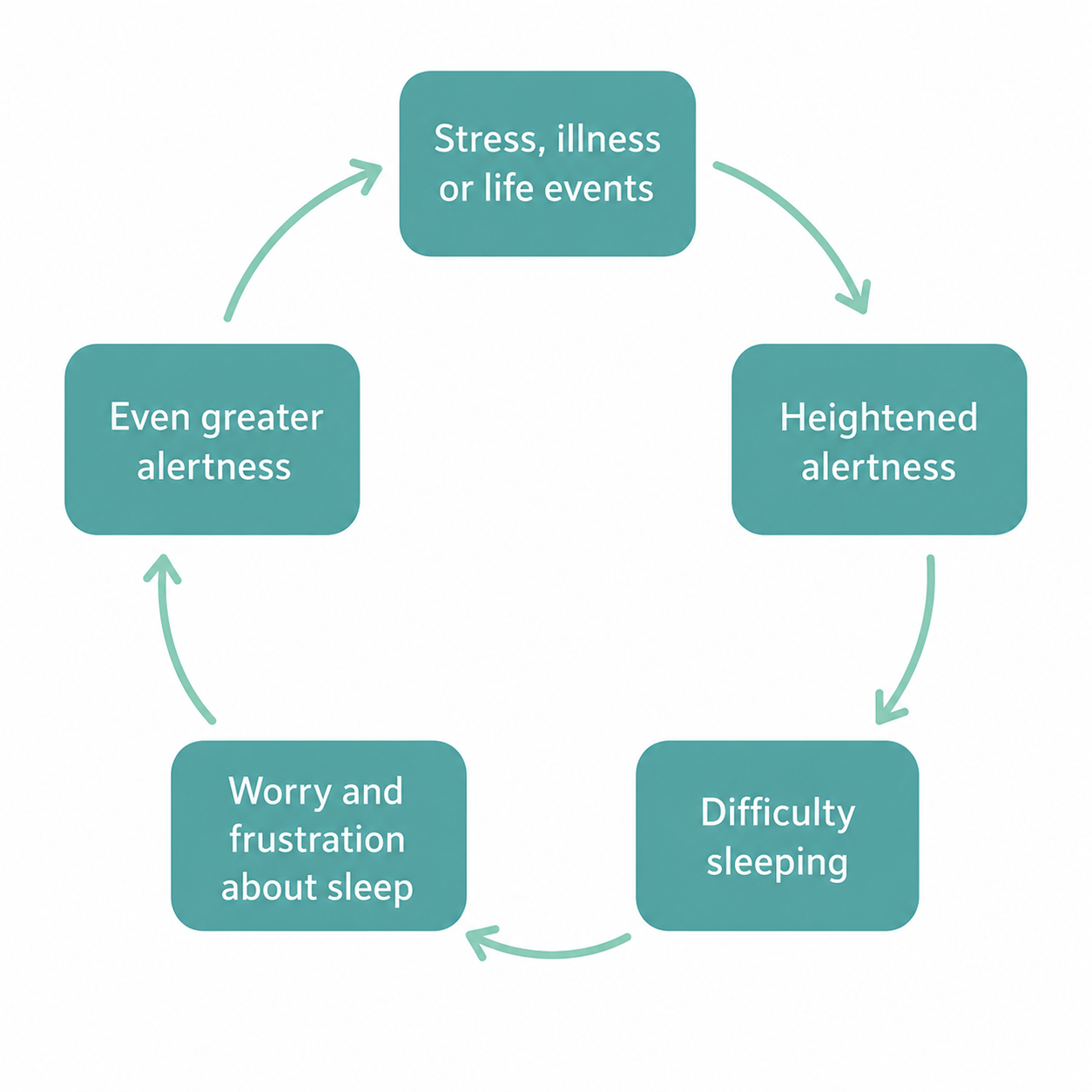
The encouraging news is that our nervous systems are capable of learning new patterns. As the emotional and physiological arousal that keeps the system on high alert begins to settle, it can become easier for the body to do what it already knows how to do naturally: sleep.
You don't have to navigate that process alone. Together, we can begin to understand what may be keeping the cycle going and gently work towards interrupting it.

"...my sleep improved almost immediately and I’ve had over a month of no insomnia, first time...in many years" - DW
Curious whether EFT could help your insomnia?
Book a free introductory conversation and we can explore whether this approach feels right for you.

How can EFT help?
One of the aims of EFT is to help interrupt this cycle. By working with the thoughts, emotions, beliefs and physical sensations that contribute to hyperarousal, many people find their nervous system becomes calmer and less reactive.
Together we might work with:
- bedtime anxiety
- racing thoughts
- stress and overwhelm
- perfectionism
- fear of not sleeping
- difficult memories
- worries about work, health or relationships
- frustration that has built up around sleep itself
Rather than trying to force sleep, our work focuses on reducing the emotional and physiological factors that may be making sleep more difficult.
Could this be the right approach for you?
If you're wondering whether EFT might help with your sleep, I'd be happy to answer your questions. There's no obligation—just an opportunity to explore whether this approach feels like a good fit.

What does EFT for insomnia look like?
No two people experience insomnia in quite the same way.
We begin by understanding your experience and exploring what may be contributing to your sleep difficulties.
Sometimes this involves recent stress or anxiety.
Sometimes it involves longstanding beliefs, emotional experiences or patterns that have become linked with bedtime.
Using EFT, we gently work with these experiences while helping your nervous system remain settled throughout.
Everything happens collaboratively, at a pace that feels right for you.
There is never any pressure to revisit anything before you feel ready.

Why work with me?
My approach to EFT is gentle, collaborative and paced with care.
While EFT can certainly be practised alone, some of the deepest and most meaningful shifts happen in the presence of another person who is fully present, attuned and listening carefully.
Feeling safe, understood and held can help us access experiences, emotions and beliefs that may otherwise remain out of reach.
From there, it often becomes possible to explore them in new ways, creating space for lasting change.
As both a qualified counsellor and an accredited EFT practitioner, I combine the structured, evidence-based approach of EFT with the depth and flexibility of psychotherapeutic counselling. This means I can support you not only through the EFT process itself, but also through whatever we encounter together along the way.

Is there research behind EFT?
EFT has been studied for a range of conditions, including anxiety, stress, depression and trauma.
These are all experiences that can contribute to poor sleep.
Research has also found improvements in sleep following EFT in a number of studies. For example, a 2025 study found "significantly improved insomnia severity, sleepiness, and sleep quality compared to a control group. You can access an up to date database of published, peer-reviewed papers on EFT and sleep here.
If you have persistent sleep difficulties, I would always encourage you to seek appropriate medical assessment.
EFT is intended to complement, not replace, medical care.
Ready to sleep a little easier?
If you're curious about whether EFT could help with your insomnia, I'd be happy to speak with you.
I offer a free introductory consultation where we can talk about your experience, answer any questions you have, and decide together whether this approach feels right for you.
Get in Touch or Book In
Not sure where to start?
You can book a free introductory consultation to ask questions, find out more about how I work and explore whether I'm the right therapist for you.
Consultations are available online or in person at my therapy room in Slaithwaite.
Ready to begin?
If you've already decided you'd like to work together, you can book an initial session directly.
Looking for more information?
You can also view my session options, packages and fees before deciding what feels right for you.
Please note, I am not a crisis service. if you are currently experiencing mental health or emotional difficulties and need immediate support you can follow this link to access contact information for other organisations who offer support.
If you are a resident of Kirklees you can contact the Kirklees emotional support helpline on 0800 183 0558. It is a 24 hour service and can support you if you are experiencing mental distress or are seeking information, support or advice regarding your mental health.